
Can Producer Prices Help Us Anticipate Future Inflation?
Inflation is one of the most closely watched economic indicators. For households, it affects purchasing power. For businesses, it influences costs, margins, and pricing decisions. For investors, it shapes interest rates, asset valuations, and portfolio strategy.One useful indicator for understanding future inflation trends is the Output Producer Price Index (OPPI). OPPI measures the prices manufacturers receive for finished goods at the factory gate, before GST, retail markups, and distribution costs are added. In simple terms, it captures price changes earlier in the supply chain, before they are fully reflected in consumer prices.Historically, movements in OPPI have often provided an early indication of subsequent changes in the Consumer Price Index (CPI), which measures the inflation households ultimately experience. The relationship is neither immediate nor perfect. However, producer prices can help signal underlying cost pressures before they become visible in headline consumer inflation.Image 1. OPPI and CPI indices over time.
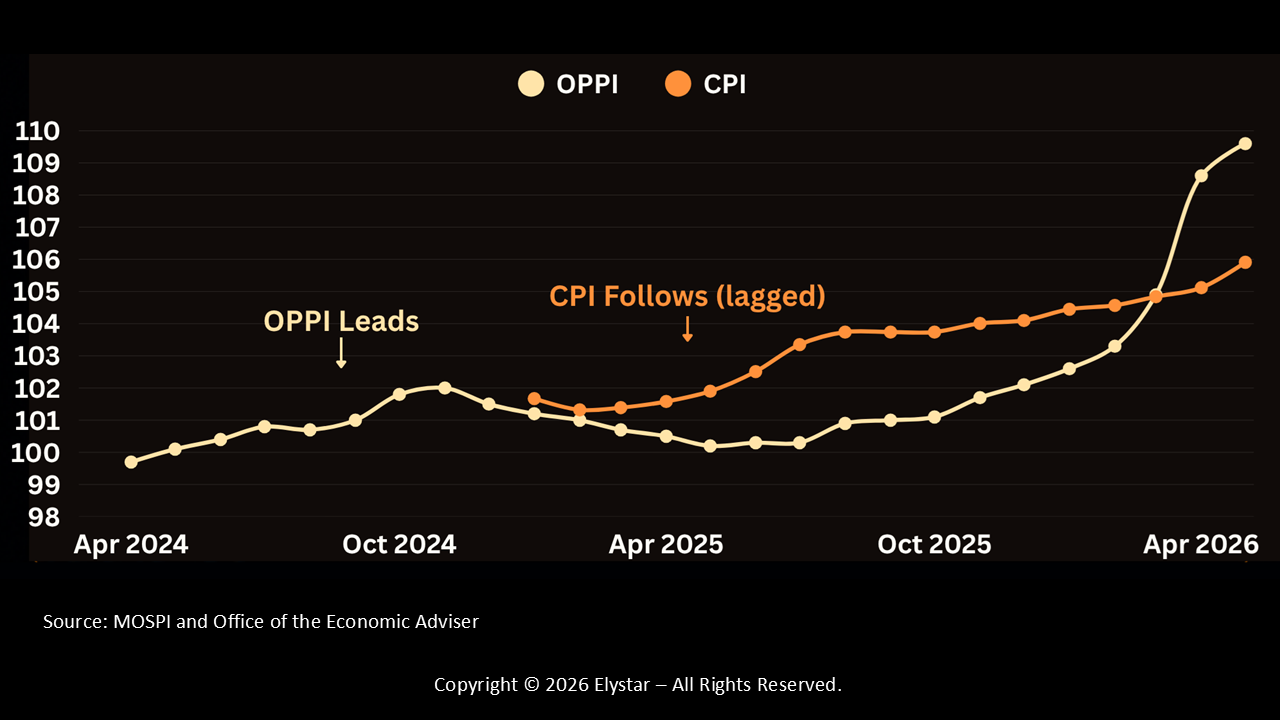
As shown in the chart (See Image 1), the increase in OPPI between April 2024 and October 2024 was followed, with a lag, by a rise in CPI between February 2025 and August 2025. This pattern illustrates how upstream cost pressures can gradually pass through to consumers over time.Producer prices can rise or fall sharply as input costs, commodity prices, exchange rates, and supply conditions change. CPI, however, is usually stickier.Businesses do not pass every change in production cost directly to consumers. Pricing decisions are influenced by contracts, competition, inventories, consumer demand, and margin considerations. As a result, some cost increases may be absorbed by businesses, while some cost declines may not be immediately passed on to consumers.This has an important implication. When producer prices soften but retail prices remain relatively unchanged, businesses may rebuild margins. This creates some room for future increases in production costs to be absorbed without an immediate rise in consumer prices. In other words, part of the adjustment often takes place through corporate profit margins rather than immediate changes in retail prices.Over the six months ending May 2026, OPPI increased by 7.8%, while CPI rose by only 1.8%. This divergence suggests that upstream cost pressures may be building, even though they have not yet been fully reflected in consumer inflation. However, this does not mean that CPI must rise sharply. If the increase in producer prices proves temporary, if businesses absorb part of the cost increase, or if other market factors offset the pressure, the pass-through to consumer inflation may remain limited.For this reason, OPPI should not be viewed as a precise predictor of inflation. Rather, it is best understood as a useful leading indicator.No single economic indicator can forecast inflation perfectly. But monitoring producer prices can provide an early window into inflation dynamics before they become visible in headline CPI.For investors, businesses, and policymakers, OPPI is therefore an important indicator to track—not because it guarantees future inflation, but because it helps identify where inflationary pressures may be forming within the economy.
Disclaimer: This content is intended solely for informational and educational purposes. It does not constitute investment, legal, tax, or financial advice, and should not be construed as a recommendation, offer, or solicitation to buy or sell any security or investment product. This is not an advertisement. While reasonable care has been taken to ensure the accuracy of the information presented, inadvertent errors or omissions may occur. Elystar Investment Management Private Limited shall not be liable for any loss or damage arising from the use of, or reliance on, this content. Past performance is not indicative of future results. Investments in the securities market are subject to market risks. Read all the related documents carefully before investing. Registration granted by SEBI, enlistment with BSE, and certification from NISM in no way guarantee performance of the intermediary or provide any assurance of returns to investors.Copyright © 2026 Elystar Investment Management Private Limited. All rights reserved. No part of this publication may be reproduced, distributed, transmitted, published, stored, modified, or used, in whole or in part, without the prior written permission of Elystar Investment Management Private Limited.
Back to all Insights
As shown in the chart (See Image 1), the increase in OPPI between April 2024 and October 2024 was followed, with a lag, by a rise in CPI between February 2025 and August 2025. This pattern illustrates how upstream cost pressures can gradually pass through to consumers over time.Producer prices can rise or fall sharply as input costs, commodity prices, exchange rates, and supply conditions change. CPI, however, is usually stickier.Businesses do not pass every change in production cost directly to consumers. Pricing decisions are influenced by contracts, competition, inventories, consumer demand, and margin considerations. As a result, some cost increases may be absorbed by businesses, while some cost declines may not be immediately passed on to consumers.This has an important implication. When producer prices soften but retail prices remain relatively unchanged, businesses may rebuild margins. This creates some room for future increases in production costs to be absorbed without an immediate rise in consumer prices. In other words, part of the adjustment often takes place through corporate profit margins rather than immediate changes in retail prices.Over the six months ending May 2026, OPPI increased by 7.8%, while CPI rose by only 1.8%. This divergence suggests that upstream cost pressures may be building, even though they have not yet been fully reflected in consumer inflation. However, this does not mean that CPI must rise sharply. If the increase in producer prices proves temporary, if businesses absorb part of the cost increase, or if other market factors offset the pressure, the pass-through to consumer inflation may remain limited.For this reason, OPPI should not be viewed as a precise predictor of inflation. Rather, it is best understood as a useful leading indicator.No single economic indicator can forecast inflation perfectly. But monitoring producer prices can provide an early window into inflation dynamics before they become visible in headline CPI.For investors, businesses, and policymakers, OPPI is therefore an important indicator to track—not because it guarantees future inflation, but because it helps identify where inflationary pressures may be forming within the economy.
Disclaimer: This content is intended solely for informational and educational purposes. It does not constitute investment, legal, tax, or financial advice, and should not be construed as a recommendation, offer, or solicitation to buy or sell any security or investment product. This is not an advertisement. While reasonable care has been taken to ensure the accuracy of the information presented, inadvertent errors or omissions may occur. Elystar Investment Management Private Limited shall not be liable for any loss or damage arising from the use of, or reliance on, this content. Past performance is not indicative of future results. Investments in the securities market are subject to market risks. Read all the related documents carefully before investing. Registration granted by SEBI, enlistment with BSE, and certification from NISM in no way guarantee performance of the intermediary or provide any assurance of returns to investors.Copyright © 2026 Elystar Investment Management Private Limited. All rights reserved. No part of this publication may be reproduced, distributed, transmitted, published, stored, modified, or used, in whole or in part, without the prior written permission of Elystar Investment Management Private Limited.
Back to all Insights
Stay informed.
Subscribe to our insights and get our latest perspectives delivered to your inbox.