
The Markets That Won Built Something the World Needed
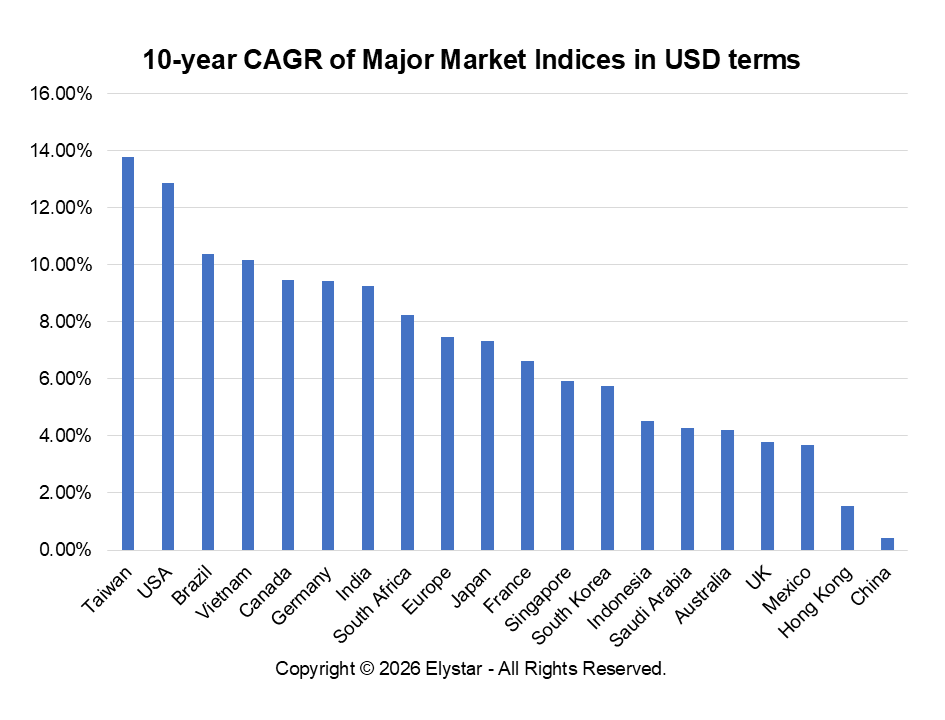
Why do some stock markets outperform others over long periods of time? Many investors look first at a country's size, population, or economic growth. While these factors matter, our analysis of 20 global stock markets from 2016 to 2025 (see Image 1) suggests a deeper explanation. The strongest-performing markets were often those where countries successfully built ecosystems that became indispensable to the global economy. Markets reward businesses. Businesses thrive within ecosystems. And ecosystems emerge when countries create the right combination of talent, infrastructure, capital, institutions, and innovation. Over the last decade, the markets that delivered the strongest returns were often backed by ecosystems that the world increasingly relied upon.Image 1. 10-year CAGR of various global stock market indices in USD terms.
Disclaimer: This content is intended solely for informational and educational purposes. It does not constitute investment, legal, tax, or financial advice, and should not be construed as a recommendation, offer, or solicitation to buy or sell any security or investment product. This is not an advertisement. While reasonable care has been taken to ensure the accuracy of the information presented, inadvertent errors or omissions may occur. Elystar Investment Management Private Limited shall not be liable for any loss or damage arising from the use of, or reliance on, this content. Past performance is not indicative of future results. Investments in the securities market are subject to market risks. Read all the related documents carefully before investing. Registration granted by SEBI, enlistment with BSE, and certification from NISM in no way guarantee performance of the intermediary or provide any assurance of returns to investors.Copyright © 2026 Elystar Investment Management Private Limited. All rights reserved. No part of this publication may be reproduced, distributed, transmitted, published, stored, modified, or used, in whole or in part, without the prior written permission of Elystar Investment Management Private Limited.
Back to all Insights
Taiwan: The Semiconductor Backbone
Taiwan's TAIEX delivered 13.76% annualized returns in USD terms, the highest among the markets analyzed. Taiwan's success was not driven by geography or size. It was driven by its position at the center of the global semiconductor ecosystem. As demand for AI, cloud computing, advanced electronics, and high-performance computing accelerated, the world became increasingly dependent on Taiwanese chip manufacturing. Through decades of investment in technology, engineering talent, and industrial capability, Taiwan built an ecosystem that became strategically important to the global economy. Its stock market performance reflected that achievement.United States: Innovation at Scale
The S&P 500 returned 12.85% annually in USD terms over the decade. The market's success was rooted in an ecosystem that fostered innovation, entrepreneurship, and capital formation. The United States remained a leader in software, cloud computing, AI infrastructure, digital platforms, biotechnology, and financial markets. Its deep capital markets and culture of innovation allowed companies to scale globally and create significant shareholder value. The lesson is not simply that the United States is a large economy. It is that the country has consistently created conditions that allow globally competitive businesses to emerge and thrive.Brazil: The Enduring Value of Resources
Brazil delivered 10.37% annualized returns in USD terms, despite periods of political uncertainty and currency volatility. The country's strength came from its role as a major supplier of commodities and agricultural products to the world. Resource-rich economies can sometimes be overlooked in discussions about technology-driven growth. Yet Brazil's performance demonstrates that ecosystems built around natural resources, agriculture, and global trade remain highly relevant. When supported by improving economic fundamentals and reforms, these ecosystems can generate substantial long-term value for investors.India: Structural Growth in Motion
India's Nifty 50 compounded at 9.24% annually in USD terms over the period. The country's growth story has been driven by several long-term structural trends: young demographics, rising household consumption, increasing digital adoption, expanding financial inclusion, and a growing entrepreneurial ecosystem. Over the last decade, India has steadily strengthened the foundations for economic growth. Investors increasingly rewarded businesses positioned to benefit from these structural changes. The market's performance reflected confidence not just in current growth, but in the country's ability to build and expand economic opportunities over time.The Bigger Lesson
The past decade offers an important investing insight. Markets do not reward countries simply because they are large, populous, or fast-growing. They reward countries that build ecosystems capable of creating value at scale. Taiwan built a world-leading semiconductor ecosystem. The United States built an innovation ecosystem that continues to shape the digital economy. Brazil leveraged its strengths in resources and agriculture. India strengthened the foundations for long-term structural growth. For investors, the question is not merely which country will grow. A more useful question is: What is this country building that the world will increasingly depend on? The answer often reveals where long-term value creation is most likely to occur.Disclaimer: This content is intended solely for informational and educational purposes. It does not constitute investment, legal, tax, or financial advice, and should not be construed as a recommendation, offer, or solicitation to buy or sell any security or investment product. This is not an advertisement. While reasonable care has been taken to ensure the accuracy of the information presented, inadvertent errors or omissions may occur. Elystar Investment Management Private Limited shall not be liable for any loss or damage arising from the use of, or reliance on, this content. Past performance is not indicative of future results. Investments in the securities market are subject to market risks. Read all the related documents carefully before investing. Registration granted by SEBI, enlistment with BSE, and certification from NISM in no way guarantee performance of the intermediary or provide any assurance of returns to investors.Copyright © 2026 Elystar Investment Management Private Limited. All rights reserved. No part of this publication may be reproduced, distributed, transmitted, published, stored, modified, or used, in whole or in part, without the prior written permission of Elystar Investment Management Private Limited.
Back to all Insights
Stay informed.
Subscribe to our insights and get our latest perspectives delivered to your inbox.