
Why the Rupee's 11% Depreciation Didn't Immediately Improve India's Trade Balance: Understanding the J-Curve Effect
The Indian rupee weakened by approximately 11% against the U.S. dollar during FY 2025–26, falling from ₹85.47 per USD on March 31, 2025, to ₹94.85 per USD on March 31, 2026. Conventional economic wisdom suggests that such a depreciation should make a country's exports more competitive, reduce imports, and ultimately stimulate economic growth. Yet, the immediate outcomes appeared to contradict these expectations. Exports showed limited momentum. Import bills remained elevated. Domestic demand for locally produced alternatives remained subdued. So, what went wrong? The answer is simple: nothing went wrong. In fact, the observed outcome is entirely consistent with established economic theory.
Disclaimer: This content is intended solely for informational and educational purposes. It does not constitute investment, legal, tax, or financial advice, and should not be construed as a recommendation, offer, or solicitation to buy or sell any security or investment product. This is not an advertisement. While reasonable care has been taken to ensure the accuracy of the information presented, inadvertent errors or omissions may occur. Elystar Investment Management Private Limited shall not be liable for any loss or damage arising from the use of, or reliance on, this content. Past performance is not indicative of future results. Investments in the securities market are subject to market risks. Read all the related documents carefully before investing. Registration granted by SEBI, enlistment with BSE, and certification from NISM in no way guarantee performance of the intermediary or provide any assurance of returns to investors.Copyright © 2026 Elystar Investment Management Private Limited. All rights reserved. No part of this publication may be reproduced, distributed, transmitted, published, stored, modified, or used, in whole or in part, without the prior written permission of Elystar Investment Management Private Limited.
Back to all Insights
The Myth of Immediate Benefits
A common misconception is that a weaker currency delivers instant economic benefits. In reality, the effects of currency depreciation take time to materialize. International trade does not adjust overnight: Export and import contracts are often fixed months in advance. Businesses cannot immediately alter sourcing decisions. Consumers do not instantly switch from imported products to domestic alternatives. Foreign buyers require time to recognize and respond to changes in relative prices. As a result, the initial impact of currency depreciation can be surprisingly counterintuitive.Understanding the J-Curve Effect
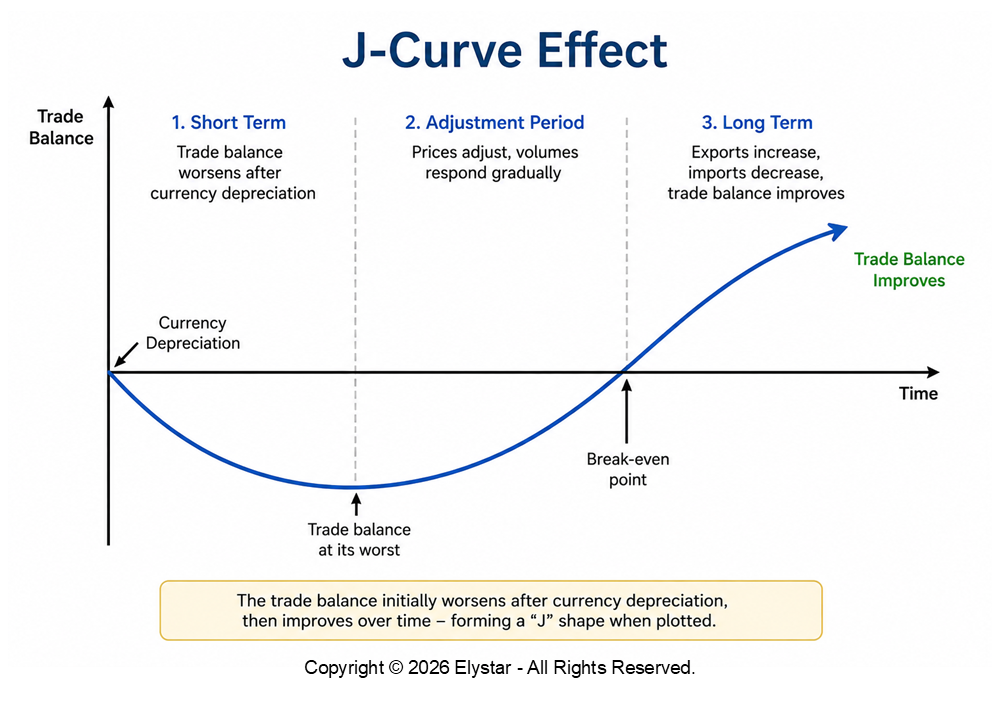
Economists describe this phenomenon through the J-Curve Effect. When a currency depreciates, the country's trade balance often deteriorates before improving. The trajectory resembles the letter "J". See Image 1.- Short-Term Impact: The trade deficit widens because import prices rise immediately in domestic currency terms, while trade volumes remain largely unchanged.
- Adjustment Period: Businesses and consumers gradually respond to changing relative prices.
- Long-Term Recovery: Export volumes increase, import demand moderates, and the trade balance begins to improve.
Why Recovery Eventually Happens
Over time, market participants adjust their behavior. Foreign buyers begin to recognize that Indian goods have become relatively cheaper in global markets, making them more attractive compared to competing products from other countries. At the same time, higher import costs encourage domestic consumers and businesses to seek locally produced substitutes wherever feasible. These gradual adjustments help strengthen exports, reduce import dependence, and improve the trade balance over the longer term. However, this recovery is not guaranteed.The Marshall-Lerner Condition: The Critical Test
Whether a depreciation ultimately improves a country's trade balance depends on a fundamental principle of international economics known as the Marshall-Lerner Condition. The condition states that currency depreciation will improve the trade balance only if: The sum of the price elasticities of demand for exports and imports is greater than one. In practical terms, this means that buyers—both domestic and international—must be sufficiently responsive to changes in prices. If demand for exports and imports remains relatively inelastic, even a substantial depreciation may fail to generate meaningful improvements in trade performance. The exchange rate may change, but behavior may not.Looking Beyond the Headlines
Exchange rate movements often generate immediate headlines and market reactions. However, understanding their true economic impact requires a longer-term perspective. A weaker currency does not automatically translate into stronger exports or a healthier trade balance. The adjustment process is gradual, shaped by contractual commitments, consumer behavior, business decisions, and demand elasticity. The key question is not whether the rupee has depreciated. The more important question is: Will businesses and consumers respond strongly enough for the economy to move up the J-Curve and satisfy the Marshall-Lerner Condition? The answer to that question will determine whether today's currency depreciation becomes tomorrow's trade recovery.Disclaimer: This content is intended solely for informational and educational purposes. It does not constitute investment, legal, tax, or financial advice, and should not be construed as a recommendation, offer, or solicitation to buy or sell any security or investment product. This is not an advertisement. While reasonable care has been taken to ensure the accuracy of the information presented, inadvertent errors or omissions may occur. Elystar Investment Management Private Limited shall not be liable for any loss or damage arising from the use of, or reliance on, this content. Past performance is not indicative of future results. Investments in the securities market are subject to market risks. Read all the related documents carefully before investing. Registration granted by SEBI, enlistment with BSE, and certification from NISM in no way guarantee performance of the intermediary or provide any assurance of returns to investors.Copyright © 2026 Elystar Investment Management Private Limited. All rights reserved. No part of this publication may be reproduced, distributed, transmitted, published, stored, modified, or used, in whole or in part, without the prior written permission of Elystar Investment Management Private Limited.
Back to all Insights
Stay informed.
Subscribe to our insights and get our latest perspectives delivered to your inbox.