
Inflation Is Rising. Is Your Portfolio Built to Handle It?
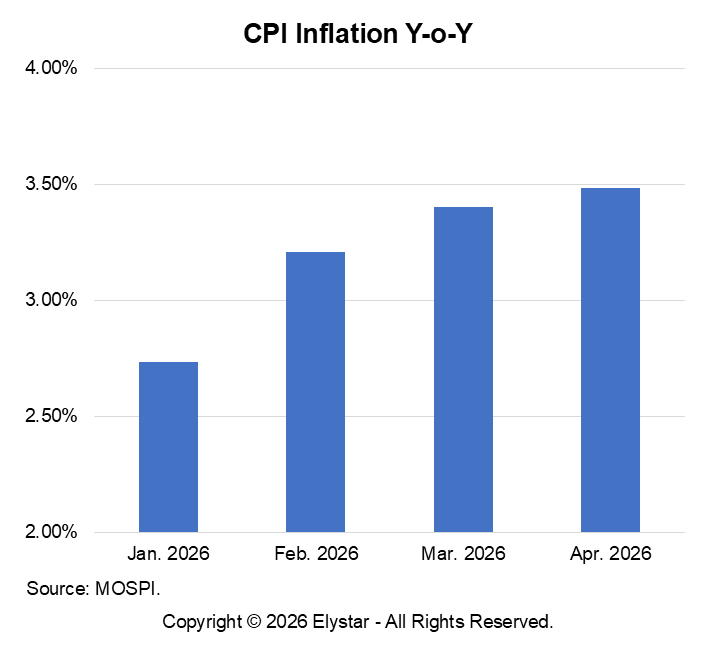
India's inflation rate has increased from 2.74% to 3.48% in just a few months. See Image 1. While this may not appear alarming at first glance, inflation is rarely about the number itself. Its true impact lies in what it does to your money over time. Inflation gradually erodes purchasing power, reducing the value of every rupee you hold. As prices rise, the same amount of money buys less than it did before. For investors, this makes understanding the relationship between inflation and asset allocation more important than ever.Image 1. CPI Inflation Y-o-Y in India.
Not all stocks perform alike during inflationary periods. Companies with strong pricing power can often pass higher costs on to consumers, helping protect profitability. However, sectors that are highly sensitive to interest rates may face temporary challenges as borrowing costs rise and consumer demand adjusts.Overall, equities have historically responded favorably to inflation over the long term, although the benefits may not be immediate. There can be a lag before businesses fully adjust pricing, margins stabilize, and markets reflect the improved earnings outlook.Debt & Bonds
Inflation can diminish the real value of fixed-income returns. As inflation expectations increase, interest rates often move higher, putting pressure on bond prices—particularly long-duration bonds. While inflation-linked bonds offer some protection, they typically provide modest real returns over the long term.Bank Fixed Deposits
Fixed deposits offer predictability and capital stability. However, when inflation rises faster than deposit rates, the real return earned by investors can become significantly lower than it appears on paper.Commodities & Natural Resources
Historically, commodities such as gold and energy resources have often performed well during periods of elevated inflation. These assets can serve as a hedge by helping preserve purchasing power when the cost of goods and services increases.Real Estate
Real estate has traditionally demonstrated an ability to adjust to inflationary environments. Property values and rental income often rise over time, helping investors maintain the real value of their investments.
Disclaimer: This content is intended solely for informational and educational purposes. It does not constitute investment, legal, tax, or financial advice, and should not be construed as a recommendation, offer, or solicitation to buy or sell any security or investment product. This is not an advertisement. While reasonable care has been taken to ensure the accuracy of the information presented, inadvertent errors or omissions may occur. Elystar Investment Management Private Limited shall not be liable for any loss or damage arising from the use of, or reliance on, this content. Past performance is not indicative of future results. Investments in the securities market are subject to market risks. Read all the related documents carefully before investing. Registration granted by SEBI, enlistment with BSE, and certification from NISM in no way guarantee performance of the intermediary or provide any assurance of returns to investors.Copyright © 2026 Elystar Investment Management Private Limited. All rights reserved. No part of this publication may be reproduced, distributed, transmitted, published, stored, modified, or used, in whole or in part, without the prior written permission of Elystar Investment Management Private Limited.
Back to all Insights
How Different Asset Classes Respond to Inflation
No asset class reacts to inflation in exactly the same way. Each responds differently depending on economic conditions, interest rates, and market sentiment.EquitiesNot all stocks perform alike during inflationary periods. Companies with strong pricing power can often pass higher costs on to consumers, helping protect profitability. However, sectors that are highly sensitive to interest rates may face temporary challenges as borrowing costs rise and consumer demand adjusts.Overall, equities have historically responded favorably to inflation over the long term, although the benefits may not be immediate. There can be a lag before businesses fully adjust pricing, margins stabilize, and markets reflect the improved earnings outlook.Debt & Bonds
Inflation can diminish the real value of fixed-income returns. As inflation expectations increase, interest rates often move higher, putting pressure on bond prices—particularly long-duration bonds. While inflation-linked bonds offer some protection, they typically provide modest real returns over the long term.Bank Fixed Deposits
Fixed deposits offer predictability and capital stability. However, when inflation rises faster than deposit rates, the real return earned by investors can become significantly lower than it appears on paper.Commodities & Natural Resources
Historically, commodities such as gold and energy resources have often performed well during periods of elevated inflation. These assets can serve as a hedge by helping preserve purchasing power when the cost of goods and services increases.Real Estate
Real estate has traditionally demonstrated an ability to adjust to inflationary environments. Property values and rental income often rise over time, helping investors maintain the real value of their investments.
Why Diversification Matters
The Mistake Many Investors Make When inflation becomes a concern, many investors focus on identifying the single best-performing asset class. This approach is often misguided. The objective should not be to find the winner of the moment, but to build a portfolio that remains resilient across a range of economic conditions. No single asset class consistently outperforms in every environment.Periods of economic uncertainty reinforce the importance of diversification. Not all equity investments carry the same characteristics. Not all debt instruments carry the same risks. Not every inflation hedge belongs in every portfolio. A well-constructed portfolio should be aligned with: financial goals, investment time horizon, liquidity requirements, and risk tolerance. The right asset allocation varies from one investor to another, making personalized portfolio construction essential.The Bottom Line
Inflation does not destroy portfolios. Unpreparedness does. The most successful investors are not necessarily those who predict every economic shift correctly. They are the ones who build portfolios capable of adapting when those shifts occur.Disclaimer: This content is intended solely for informational and educational purposes. It does not constitute investment, legal, tax, or financial advice, and should not be construed as a recommendation, offer, or solicitation to buy or sell any security or investment product. This is not an advertisement. While reasonable care has been taken to ensure the accuracy of the information presented, inadvertent errors or omissions may occur. Elystar Investment Management Private Limited shall not be liable for any loss or damage arising from the use of, or reliance on, this content. Past performance is not indicative of future results. Investments in the securities market are subject to market risks. Read all the related documents carefully before investing. Registration granted by SEBI, enlistment with BSE, and certification from NISM in no way guarantee performance of the intermediary or provide any assurance of returns to investors.Copyright © 2026 Elystar Investment Management Private Limited. All rights reserved. No part of this publication may be reproduced, distributed, transmitted, published, stored, modified, or used, in whole or in part, without the prior written permission of Elystar Investment Management Private Limited.
Back to all Insights
Stay informed.
Subscribe to our insights and get our latest perspectives delivered to your inbox.