
Beyond Sectoral Tailwinds: What Really Drove Wealth Creation in India Over the Last Decade
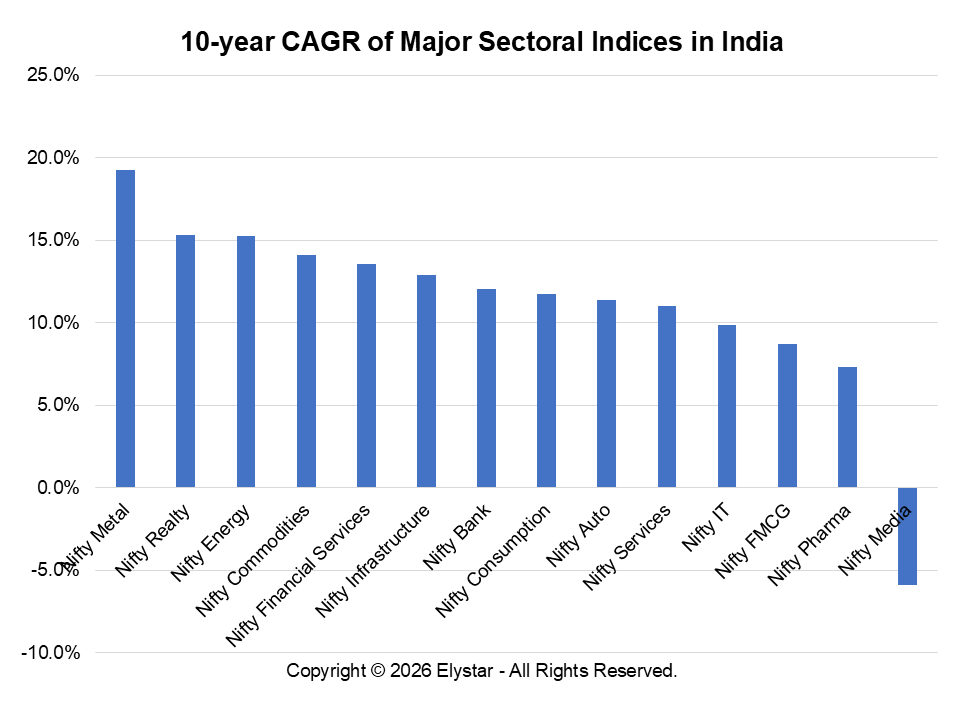
Investors often begin by identifying sectors that stand to benefit from favourable economic, regulatory, or technological trends. See Image 1.Image 1. 10-year CAGR of major sectoral indices in India.
While sectoral tailwinds undoubtedly create opportunities, they do not determine where wealth creation ultimately occurs. Strong business models, disciplined execution, and the ability to adapt are what separate long-term winners from the rest. A review of India's listed companies over the last decade offers a compelling illustration of this principle.
Back to all Insights
While sectoral tailwinds undoubtedly create opportunities, they do not determine where wealth creation ultimately occurs. Strong business models, disciplined execution, and the ability to adapt are what separate long-term winners from the rest. A review of India's listed companies over the last decade offers a compelling illustration of this principle.
Metals: More Than a Commodity Story
The metals sector benefited significantly from India's capex revival and favourable global commodity cycles. However, the most successful businesses were often those that moved beyond pure commodity exposure. Companies that focused on integration, downstream products, value-added offerings, and stronger competitive positioning were generally better placed to sustain growth and create shareholder value. The lesson is clear: participation in a favourable cycle helps, but differentiation determines who captures the greatest share of the opportunity.Real Estate: Consolidation Created Leaders
The transformation of India's real estate sector was not simply a function of land ownership or scale. Regulatory changes such as RERA accelerated industry consolidation, while stronger balance sheets, improved governance standards, and access to capital enabled certain developers to strengthen their market position. At the same time, growing demand for premium housing and commercial real estate created opportunities for well-positioned players to pull away from the broader industry. The result was a widening gap between leaders and laggards within the same sector.Energy: Looking Beyond Traditional Classifications
Viewed through traditional sector classifications, energy may appear to have delivered only moderate returns over the decade. However, a closer examination reveals that significant value creation occurred in adjacent and enabling segments. Businesses involved in power infrastructure, transmission networks, electrical equipment, renewable energy, and grid modernisation benefited from structural changes in India's energy ecosystem. In many cases, these businesses created more value than conventional energy companies that were exposed primarily to traditional generation or commodity-linked activities. This highlights the importance of understanding where value is being created within an industry rather than relying solely on broad sector labels.Media: A Lesson in the Value of Ownership
Media was among the weakest-performing sectors during the period. Yet even within a challenged industry, outcomes varied significantly. Businesses that owned valuable content, brands, or intellectual property generally fared better than those whose primary advantage was distribution. As digital platforms expanded consumer choice and reduced barriers to access, ownership of content became increasingly valuable, while distribution advantages became less durable. The pattern is not unique to media; it reflects a broader shift occurring across industries.The Real Lesson: Business Models Matter More Than Sectors
The most important takeaway from the last decade is that sectors alone rarely determine investment outcomes. Instead, the market has consistently rewarded businesses that:- Adapted to emerging opportunities and changing consumer needs.
- Moved up the value chain through innovation and value addition.
- Built intellectual property, brands, and proprietary capabilities.
- Strengthened customer relationships and created switching costs.
- Maintained strong execution and disciplined capital allocation.
The Commoditisation of Distribution
Perhaps the most significant structural shift of the last decade has been the gradual commoditisation of distribution. Technology has lowered barriers to access, expanded reach, and increased transparency across industries. As a result, a growing share of economic value is accruing to businesses that own brands, content, technology, data, intellectual property, or other differentiated capabilities, rather than those that merely connect producers and consumers. This trend is evident across sectors—from media and consumer businesses to industrials, manufacturing, and technology-enabled services.Conclusion
The last decade demonstrates that sectoral tailwinds create opportunities, but they do not guarantee success. Within every sector, some businesses capture disproportionate value while others struggle despite operating in the same environment. For investors, the implication is straightforward: identifying the right sector is only the starting point. Long-term wealth creation is more likely to come from understanding which businesses possess the competitive advantages, adaptability, and execution capabilities needed to convert industry growth into sustainable shareholder returns. In the long run, markets appear to reward ownership of value creation far more than ownership of distribution. Disclaimer: This content is intended solely for informational and educational purposes. It does not constitute investment, legal, tax, or financial advice, and should not be construed as a recommendation, offer, or solicitation to buy or sell any security or investment product. This is not an advertisement. While reasonable care has been taken to ensure the accuracy of the information presented, inadvertent errors or omissions may occur. Elystar Investment Management Private Limited shall not be liable for any loss or damage arising from the use of, or reliance on, this content. Past performance is not indicative of future results. Investments in the securities market are subject to market risks. Read all the related documents carefully before investing. Registration granted by SEBI, enlistment with BSE, and certification from NISM in no way guarantee performance of the intermediary or provide any assurance of returns to investors.Copyright © 2026 Elystar Investment Management Private Limited. All rights reserved. No part of this publication may be reproduced, distributed, transmitted, published, stored, modified, or used, in whole or in part, without the prior written permission of Elystar Investment Management Private Limited.Back to all Insights
Stay informed.
Subscribe to our insights and get our latest perspectives delivered to your inbox.